
API Penetration Testing
REST, GraphQL or SOAP: our security experts test your APIs and web services manually against the OWASP API Security Top 10, from authentication to business flows.
- REST
- GraphQL
- SOAP & Web Services
- OWASP API Security Top 10
- BOLA / IDOR
- Broken Authentication
- JWT & OAuth 2.0
- Mass Assignment
- Rate Limiting
- Injection
- SSRF
- API Security
What we test
Depending on your environment and the agreed scope, we examine in particular:
Authentication (Broken Authentication)
Review of the authentication mechanisms in use, such as API keys, OAuth 2.0 and OpenID Connect, of the handling of tokens (e.g. signature, validity and revocation of JWTs) and of the protection against brute-force attacks.
Authorisation at Object and Function Level (Broken Object Level Authorization, Broken Function Level Authorization)
Review of whether users can only access the objects, data and functions they are authorised to, for example by manipulating object IDs or by calling administrative endpoints.
Authorisation at Object Property Level (Broken Object Property Level Authorization)
Investigation of whether API endpoints return more information than necessary, including sensitive or internal data, or allow changes to properties that must not be modified (mass assignment).
Input Validation and Injection
Testing the processing of parameters and requests (e.g. JSON or XML) for vulnerabilities such as SQL, NoSQL or OS command injection and for insufficient schema validation.
Resource Consumption (Unrestricted Resource Consumption)
Verification of whether rate limits, size limits and pagination are sufficient to prevent abuse and the exhaustion of resources. Tests that could impair the availability of the API are only carried out after explicit agreement with you confirmed in text form.
Business Flows (Unrestricted Access to Sensitive Business Flows)
Assessment of whether legitimate functions and business flows can be misused for unauthorised or harmful purposes, for example through automation.
Server-Side Request Forgery (SSRF)
Testing whether the API fetches supplied URLs without sufficient checks and thereby allows requests to internal systems.
Security Misconfiguration
Identification of weaknesses in the configuration, for example in CORS, HTTP methods, TLS and security headers, and of error handling that discloses internal information.
API Inventory (Improper Inventory Management)
Identification of undocumented, outdated or no longer maintained API versions, endpoints and environments (e.g. test or staging systems).
Consumption of Third-Party APIs (Unsafe Consumption of APIs)
Testing whether data from connected third-party APIs is processed without sufficient validation.
GraphQL-Specific Weaknesses
For GraphQL APIs, review of introspection, limits on query depth and complexity, batching and authorisation at field level.
File Uploads
Testing whether the API allows the upload and execution of malicious files that could compromise the system.
Third-Party Components
Identification of outdated libraries and components with known vulnerabilities used by the API.
How it works
- 1Scoping
Objectives, rules of engagement and time frame, agreed in writing.
- 2Testing
Hands-on testing by experienced analysts, supported by tools.
- 3Reporting
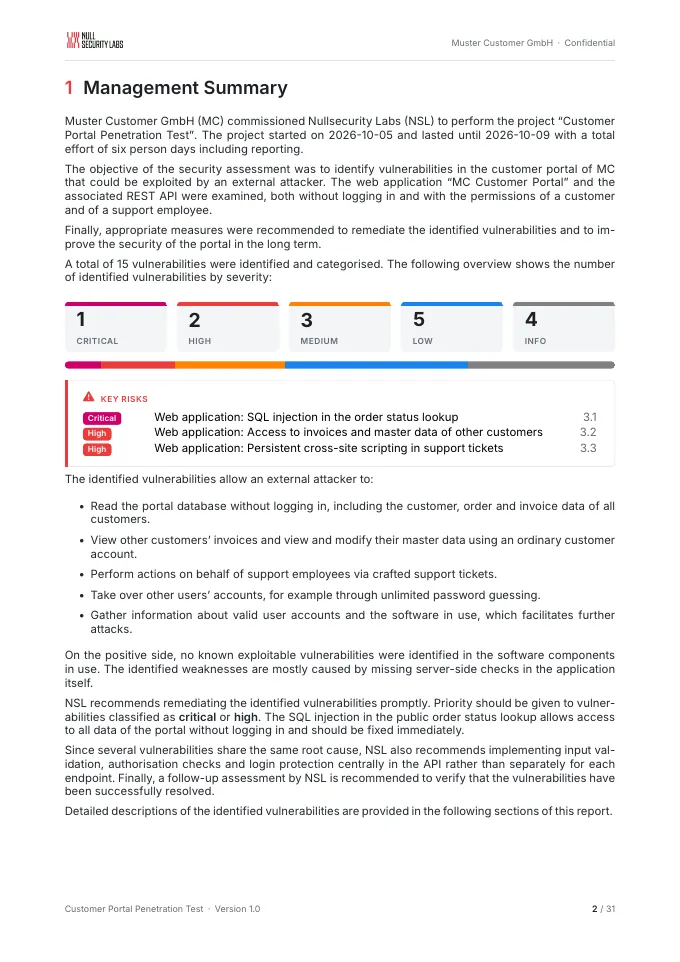
Management summary, reproducible findings and remediation advice.
- 4Retest
On request, we verify your fixes and update the report.
What you receive
- Management summary, understandable without prior technical knowledge
- Overview of all findings with their risk rating
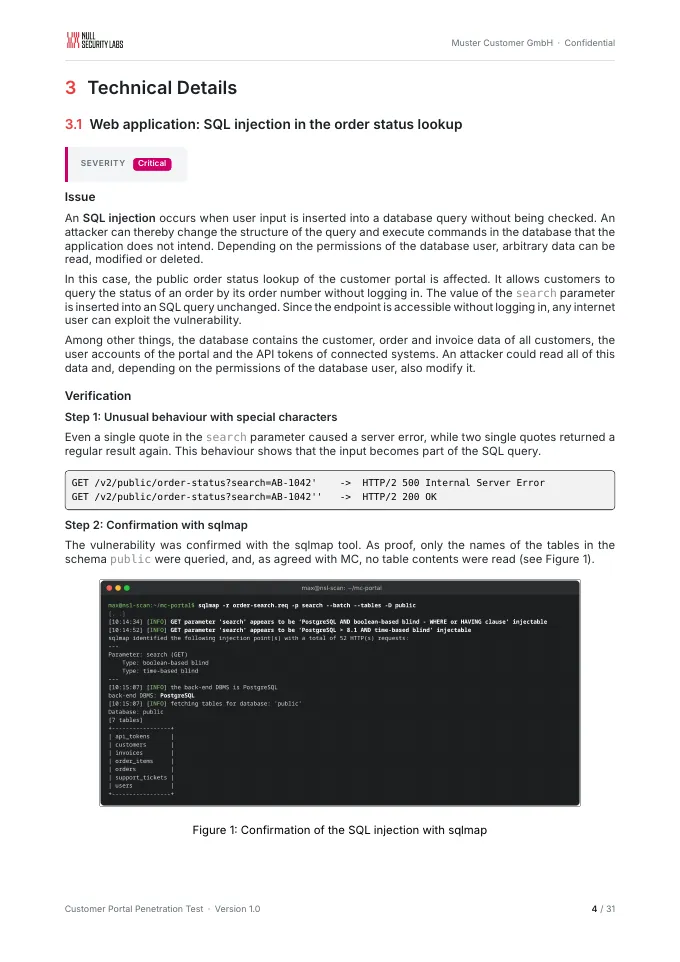
- Technical details for each vulnerability: affected systems, evidence and specific remediation advice
- Description of the procedure, the tools used and the rating scheme
- Report in English or German
- On request a retest of your fixes and an updated report
More penetration testing areas
Web Application Penetration Testing
OWASP Top 10, injection, XSS, access control and business logic.
Learn moreExternal Penetration Testing
Everything an attacker reaches from the internet: VPN, mail, firewalls.
Learn moreInternal & Active Directory Penetration Testing
Internal network and Active Directory, from a workstation to domain admin.
Learn morePenetration Testing
In-depth security tests of all system components from the perspective of an external or internal attacker.
Learn moreNot sure where to start?
Tell us about your environment, and we will propose a scope that fits.