
Web Application Penetration Testing
Our security experts attack your web application the way real attackers do: manually, beyond scanner results, from the login to the business logic.
- OWASP Top 10
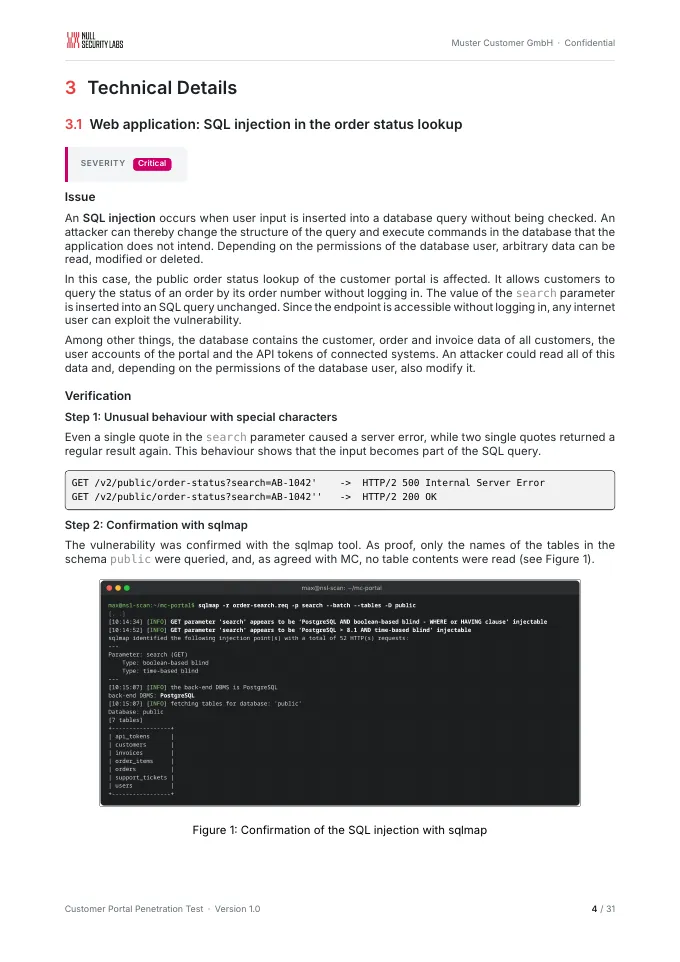
- SQL Injection
- Cross-Site Scripting (XSS)
- CSRF
- SSRF
- Broken Access Control / IDOR
- Authentication & SSO
- Session Management & JWT
- Business Logic
- File Upload
- Security Headers & TLS
- Web Application Security
What we test
Depending on your environment and the agreed scope, we examine in particular:
Authentication
Examination of login procedures, password policies, password reset functions, the protection against brute-force attacks and against the enumeration of valid user accounts, Single Sign-On (SSO, e.g. OAuth 2.0, OpenID Connect or SAML) and multi-factor authentication (MFA) for weaknesses that could allow unauthorised access.
Session Management
Evaluation of session handling, including session cookies and tokens (e.g. JWT), session expiration, logout and the protection against session fixation and session hijacking.
Access Control (Broken Access Control)
Review of whether users can only access the data and functions they are authorised to, both horizontally (e.g. data of other users or tenants via Insecure Direct Object References, IDOR) and vertically (e.g. administrative functions).
Injection Vulnerabilities
Investigation of whether an attacker can inject malicious code or commands, for example via SQL, NoSQL, OS command, LDAP or template injection (SSTI).
Cross-Site Scripting (XSS)
Analysis for reflected, stored and DOM-based XSS vulnerabilities that could allow an attacker to execute malicious JavaScript code in the browsers of other users.
Cross-Site Request Forgery (CSRF) and Clickjacking
Check for vulnerabilities that could allow an attacker to perform actions on behalf of an authenticated user.
Server-Side Vulnerabilities
Testing for vulnerabilities such as Server-Side Request Forgery (SSRF), XML External Entities (XXE), path traversal, file inclusion and insecure deserialisation.
File Uploads
Checking the upload functions for vulnerabilities that could allow an attacker to upload and execute malicious files or to access the files of other users.
Business Logic
Review of business processes and workflows for logic flaws, for example the manipulation of prices or quantities, the skipping of process steps or race conditions.
Security Misconfigurations
Review of the application and the web server for insecure settings, such as exposed HTTP methods, debug or administration interfaces, directory listings, backup files, missing security headers (e.g. Content Security Policy, HSTS) and insecure CORS configurations.
Information Disclosure
Review of whether error messages, comments, source code or responses disclose internal information such as stack traces, software versions or internal paths.
Protection of Sensitive Data
Review of whether sensitive data such as passwords, payment information or personal data is transmitted and stored securely, including the TLS configuration.
Third-Party Components
Identification of outdated libraries, frameworks and components with known vulnerabilities.
Client-Side Security
Analysis of the client-side code (e.g. JavaScript of single-page applications) for sensitive information, insecure data storage in the browser and weaknesses such as open redirects or insecure communication between windows (postMessage).
Denial-of-Service (DoS) Attacks
Evaluation of whether individual functions can be abused to exhaust resources. Tests that could impair the availability of the application are only carried out after explicit agreement with you confirmed in text form.
How it works
- 1Scoping
Objectives, rules of engagement and time frame, agreed in writing.
- 2Testing
Hands-on testing by experienced analysts, supported by tools.
- 3Reporting
Management summary, reproducible findings and remediation advice.
- 4Retest
On request, we verify your fixes and update the report.
What you receive
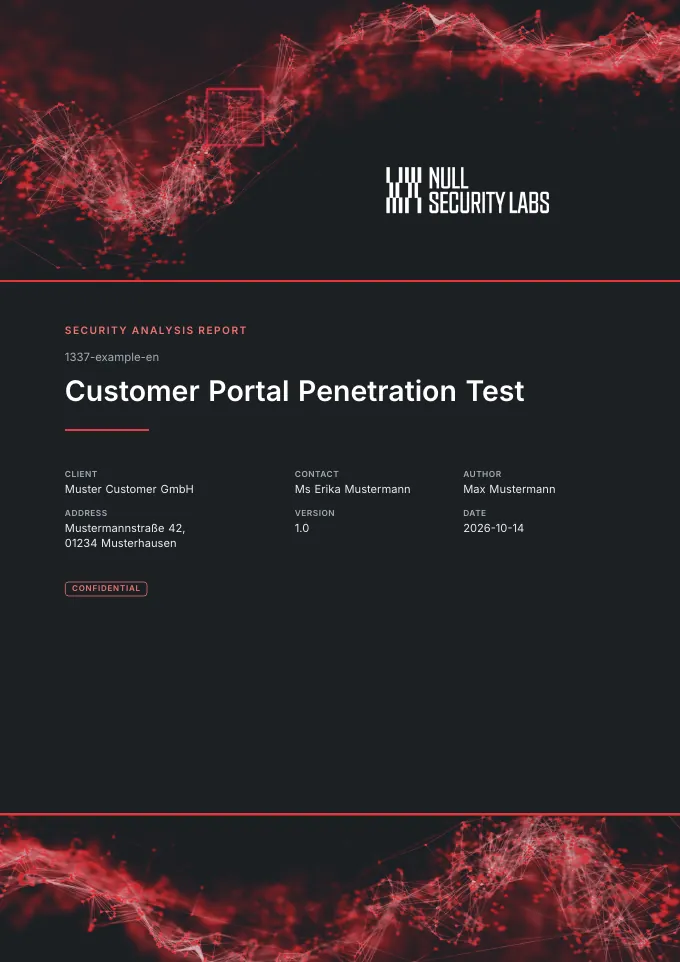
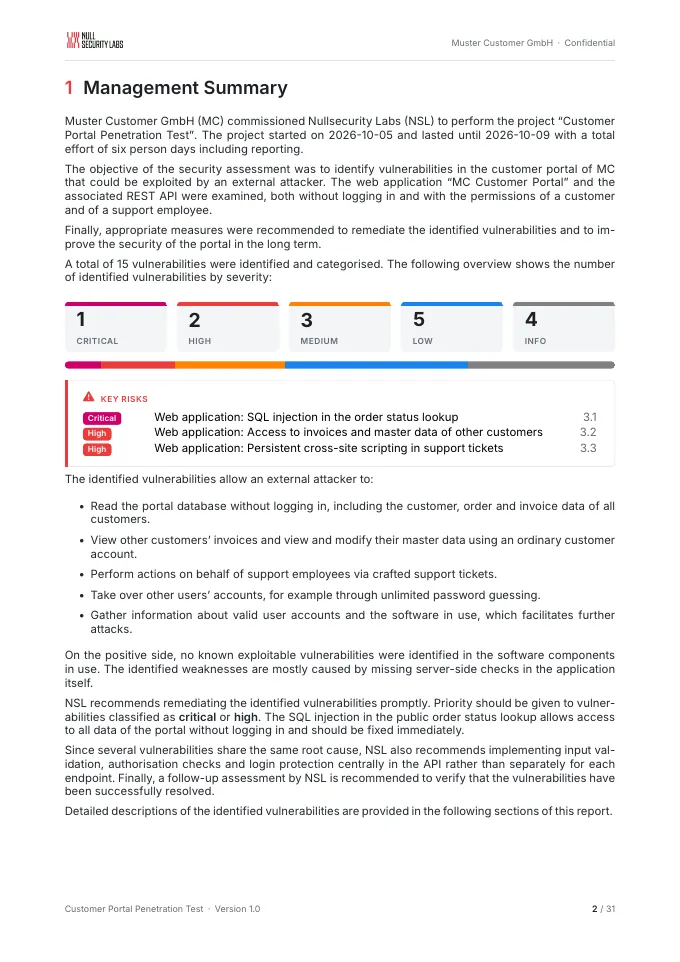
- Management summary, understandable without prior technical knowledge
- Overview of all findings with their risk rating
- Technical details for each vulnerability: affected systems, evidence and specific remediation advice
- Description of the procedure, the tools used and the rating scheme
- Report in English or German
- On request a retest of your fixes and an updated report
More penetration testing areas
API Penetration Testing
REST, GraphQL and web services: authorisation, tokens and business flows.
Learn moreExternal Penetration Testing
Everything an attacker reaches from the internet: VPN, mail, firewalls.
Learn moreInternal & Active Directory Penetration Testing
Internal network and Active Directory, from a workstation to domain admin.
Learn morePenetration Testing
In-depth security tests of all system components from the perspective of an external or internal attacker.
Learn moreNot sure where to start?
Tell us about your environment, and we will propose a scope that fits.